
As we made our way across South America, the one place that stayed in the back of my mind the entire time was Machu Picchu. It’s one of those iconic sites that I had dreamed about seeing long before the journey began.
While winding our way down the adventurous Ruta 3N in Peru, I kept thinking, We really need to start planning this. Visiting Machu Picchu isn’t something you just stumble into—especially as an overlander. Between figuring out how to safely store the vehicle and securing tickets in advance, there are a few key steps that take a bit of coordination. So I put together this post to help anyone else making the journey—a clear, step-by-step guide just for overlanders.
There are five main things you’ll need to arrange:
- Vehicle storage
- Train tickets
- Entrance passes to Machu Picchu
- Bus tickets from Aguas Calientes to Machu Picchu
- Accommodations in Aguas Calientes
Each one requires a little bit of research and timing, but once it’s all in place, the experience is 100% worth it. Let’s break it all down, step by step, so you can get there without the stress.


1. Vehicle Storage: First Step for Overlanders Visiting Machu Picchu
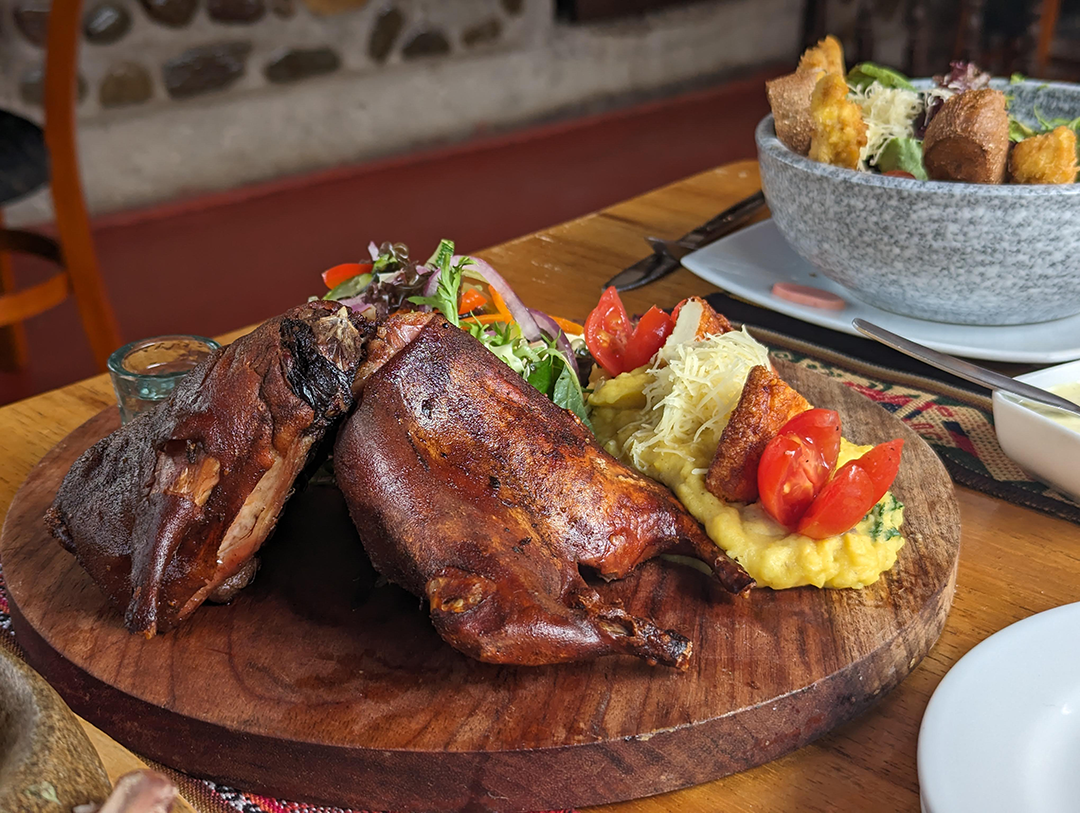
Before you can visit Machu Picchu, the first thing to figure out is where to store your vehicle. You’ll need to decide whether to start your journey from the Cusco area or drive about 1.5 hours to Ollantaytambo, a charming town that offers its own set of attractions. We personally recommend leaving from Ollantaytambo, as we really enjoyed spending extra time there. The Inca ruins in the center of town are impressive, and there’s plenty of great local food to try—including cuy (guinea pig), which we finally tasted here!
There’s also a third option for more adventurous and budget-conscious travelers: driving to the small village of Santa Teresa. From there, you can either take the PeruRail train to Aguas Calientes or walk 11 km along the train tracks to the town. It’s not for everyone, but for those looking to save money and add adventure, it’s a great alternative.
If you choose to leave from Cusco, we recommend staying at the well-known overlander campground Quinta Lala. It’s conveniently located near the Sacsayhuamán ruins and offers both short- and long-term vehicle storage. It’s also a great option if you’re planning to fly home and leave your vehicle for a longer stretch.
For those leaving from Ollantaytambo, there are a few parking options with different price points and levels of comfort. Some overlanders use the large municipal lot or other paid parking areas around town, but we found those a bit too busy for our taste. If you’re looking for something more peaceful, there are also formal campgrounds like Rey Inca and Las Canteras. While a bit farther from the town center and more expensive, they offer added amenities and more tranquility. We chose to stay at Rey Inca and felt it was a safe and quiet place to leave the truck—aside from the occasional train horn.



2. Train Tickets: How to Choose Your Train Experience
Once you’ve figured out your vehicle storage, the next step is deciding how you want to get to Machu Picchu. Most people either hike one of the multi-day treks—like the famous Inca Trail—or take the train. There are several hiking options of varying lengths, but since we took the train, we’ll focus on that here.
There are two main train companies: PeruRail and Inca Rail. Both offer good service, scenic rides, and a range of comfort levels. The main differences come down to pricing, departure locations, and onboard experience.
PeruRail is the older of the two (operating since 1999) and offers three types of train service:
- Expedition Train – Budget-friendly
- Vistadome – Mid-range with panoramic windows
- Hiram Bingham – Luxury option, complete with gourmet dining and an open bar
PeruRail trains depart from both Cusco (Poroy Station) and Ollantaytambo. If you’re planning to leave from Cusco, just note that Poroy Station is located about 30 to 45 minutes by taxi from the city center, and trains from Poroy only operate from April through December. One of the main advantages of choosing PeruRail is that it offers more frequent daily departures and a truly luxurious experience if you opt for the top-tier cars.
Inca Rail, founded in 2007, has a more modern feel. It was our choice mainly because the dates and prices worked better for us compared to PeruRail. If you’re starting in Cusco, Inca Rail trains can depart from San Pedro Station, which is right in the historic center—no taxi ride needed. However, there are fewer departures from San Pedro Station, in comparison to the Poroy Station, and the trip takes much longer than from Ollantaytambo.
Inca Rail also offers three classes:
- The Voyager – Budget-friendly
- The 360° – Mid-range with access to the viewing deck
- First Class – Luxury with gourmet food and beverage service
We chose the 360° Train, and it was a fantastic experience. One of the unique features is the open-air viewing deck, where we enjoyed some live music. Back at our seats, we were served a small snack, and there was a short performance that added a fun cultural element to the ride.
The biggest advantage of Inca Rail is that it’s often more budget-friendly than PeruRail, but it’s always smart to check both websites and compare prices, as they vary depending on season and availability.


3. Entrance Passes to Machu Picchu: What You NEED to Know
Machu Picchu has a daily visitor limit of 4,500 people per day! Entrance is based on a time-slot- entry with the first time being 6:00 AM and the last being 2:00 PM. Once you’re inside, you cannot backtrack, switch circuits, or re-enter the site with the same ticket. So it’s important to know what you’re booking ahead of time.
As of June 1, 2024, the updated system offers 3 circuits with a total of 10 routes. Each circuit has different highlights, and the route you choose will shape your experience. Here’s a quick overview:
- Circuit 1 – Panoramic Route: Best for the classic postcard views and elevated lookout points. (4 route options)
- Circuit 2 – Classic Circuit: The most comprehensive, including the urban and religious sectors. (3 route options)
- Circuit 3 – Royal Circuit: Focuses on the lower sectors, including areas used by nobility. (3 route options)
Since tickets for certain circuits can sell out months in advance, especially in high season, planning ahead is key. Here are the main ways to get your tickets:
Option 1 – Buy Your Tickets Online
We know that as overlanders, travel plans are often unpredictable, but if you already know your timeline, booking online through the official government site is your best bet. You’ll need to select your circuit, specific route, date, time slot, and origin. The process is fairly straightforward—but be aware: tickets are non-refundable and non-changeable once purchased.
Option 2 – Purchase the Tickets In Person
The most important thing to remember about buying tickets in person is that they are valid for the day after the purchase, not same-day. That means if you plan to buy your ticket in Aguas Calientes, you’ll need to arrive at least one day before your visit, so plan for an extra night of accommodation.
Here are the places to purchase tickets in person:
- Ministry of Culture, Aguas Calientes (Avenue Pachacutec) – Buy one day before you plan to visit the site
- Ministry of Culture, Cusco (Casa Garcilaso, Calle Garcilaso) – Official government office
Keep in mind, availability in person can be limited, and lines can be long—so this option carries some risk. We have first hand accounts of other overlanders waiting three days in Aguas Calientes to get a ticket in the high season, so the most stress free option is to book online in advance if possible.
Option 3 – Go with a Tour Operator
Many overlanders prefer the DIY approach, but if you’d rather take the guesswork out, you can book a full package with a tour company. These usually include your train tickets, Machu Picchu entrance, bus tickets, and sometimes even accommodation in Aguas Calientes. It’s the most convenient option, but it does come at a higher price.


4. Bus tickets from Aguas Calientes to Machu Picchu
Once you arrive in Aguas Calientes, you might think you’ve made it—but there’s still one more step before entering Machu Picchu. From town, you can either hike up to the entrance or take a shuttle bus, which is the more relaxing option—especially if you’re planning to get there for an early time slot.
Bus tickets can be purchased directly in Aguas Calientes at the ticket office, located near the bus stop on Avenue Hermanos Ayar. Tickets can be bought on the day of your visit or in advance, which is highly recommended during the high season to avoid long queues. The office is open daily from 5:00 AM to 9:00 PM, and the process is one of the least stressful parts of the entire Machu Picchu planning experience.
You have the choice of purchasing a one-way or round-trip ticket. For those on a budget or who enjoy a good walk, you might consider taking the bus up to the site and then walking back down—it’s downhill and offers a scenic route back to town. The bus ride takes about 30 minutes each way.
Buses start departing at 5:30 AM, running approximately every 10 minutes throughout the day, and the last return bus from the site leaves at 5:30 PM. During peak morning hours (especially between 5:00 and 8:00 AM), expect lines to be long. Whether you choose to ride or walk, knowing what to expect makes the final stretch of your journey to Machu Picchu much easier to navigate.


5. Overnight Accommodations: Why We Stayed Three Nights
One of the biggest advantages we have as overlanders, compared to fly-in tourists, is flexibility. After putting so much effort and money into reaching Machu Picchu, we didn’t want to rush the experience. We chose to stay three nights in Aguas Calientes, booking a budget-friendly room at Tierra Inn. The first night gave us time to relax after the train ride and enjoy some local food. The second night was for resting after visiting the site. And the third night? A little bit of overkill—but totally worth it. It gave us a backup day in case of bad weather, so we could revisit Machu Picchu with a new entrance ticket if needed. Since this was a once-in-a-lifetime bucket list experience for me, I wanted to make sure nothing got in the way of seeing it properly.
Another benefit of staying multiple nights is that, in our experience, the train tickets were the most expensive part of the trip. Once you’re in Aguas Calientes, it makes sense to take your time and consider exploring multiple circuits if you’re able to get tickets. We had time to walk around town, relax, and try out some local restaurants. While we sampled a few, the one that stood out was Toto’s House. Be sure to request a table on the second floor for a gorgeous view of the Urubamba River. Our favorite dishes were the roast lamb leg and the grilled alpaca, both full of flavor and beautifully presented.


Final Thoughts: Do You Need a Guide?
When you arrive in Aguas Calientes, you’ll quickly notice that there are plenty of local guides offering their services. And once you’re in line for the bus up to Machu Picchu, you’ll find even more guides actively introducing themselves to travelers and offering to accompany you. We hadn’t planned on hiring a guide but made the decision last minute, and we’re glad we did.
Having a guide added so much depth to the experience. We would have missed out on a lot of interesting history and context that really brought the site to life. Our guide was fantastic, and you can see just how much we learned in our video, “We Drove to Machu Picchu”. He shared so many facts and stories that we would have never known on our own. You can check out the video and decide for yourself if a guide is worth considering.


If Machu Picchu is on your bucket list like it was on mine, hopefully this post has everything you need to make the journey smooth, stress-free, and unforgettable.
 Everlanders